Improving Internet Accessibility
 With
With

- Phases
- understand define deliver sustain
- Modality
- Clinic
- Status
- Complete
User research and design strategy for Weblate, the open source localization platform powering much of the world's free software. Threading the needle between feature-rich and focused.
Weblate is the open source localization platform behind thousands of software projects. Its capabilities have consistently grown over the years, and this wealth of features started to impact user experience, with users struggling with feature discovery, reporting, and onboarding of new contributors. Draftlab partnered with Ura Design on a UXD Lab engagement to understand and surface these pain points, and propose a sequenced path forward.
Between December 2025 and February 2026, we conducted 15 in-depth interviews with translators, reviewers and managers, alongside 68 survey responses gathered at FOSDEM and through translation communities. The core finding: Weblate already has most of the features its users need, they just can't easily find or use them.
We identified four interconnected pain points (feature discoverability, reporting and data extraction, onboarding, and translator appreciation), and proposed four solutions: a streamlined translation view, revised user roles, a visual dashboard for managers, and an improved onboarding experience. To help with planning and prioritization, we sequenced three implementation stages, starting from lowest-effort, highest-impact changes. Ura Design translated these into working prototype mockups that provided a clear visual and UX direction, focused mainly on the translation view and an exploratory manager dashboard.
Skills applied
Updates
Research delivered, findings handed to Weblate
Final report shared with the Weblate team to inform their product roadmap, and with Ura Design to support prototype work. We provided detailed feedback on Ura's translation view mockups and proposed an exploratory dashboard concept drawn from the manager interviews, both reflected in Ura's iterated designs.
Four pain points, four solutions
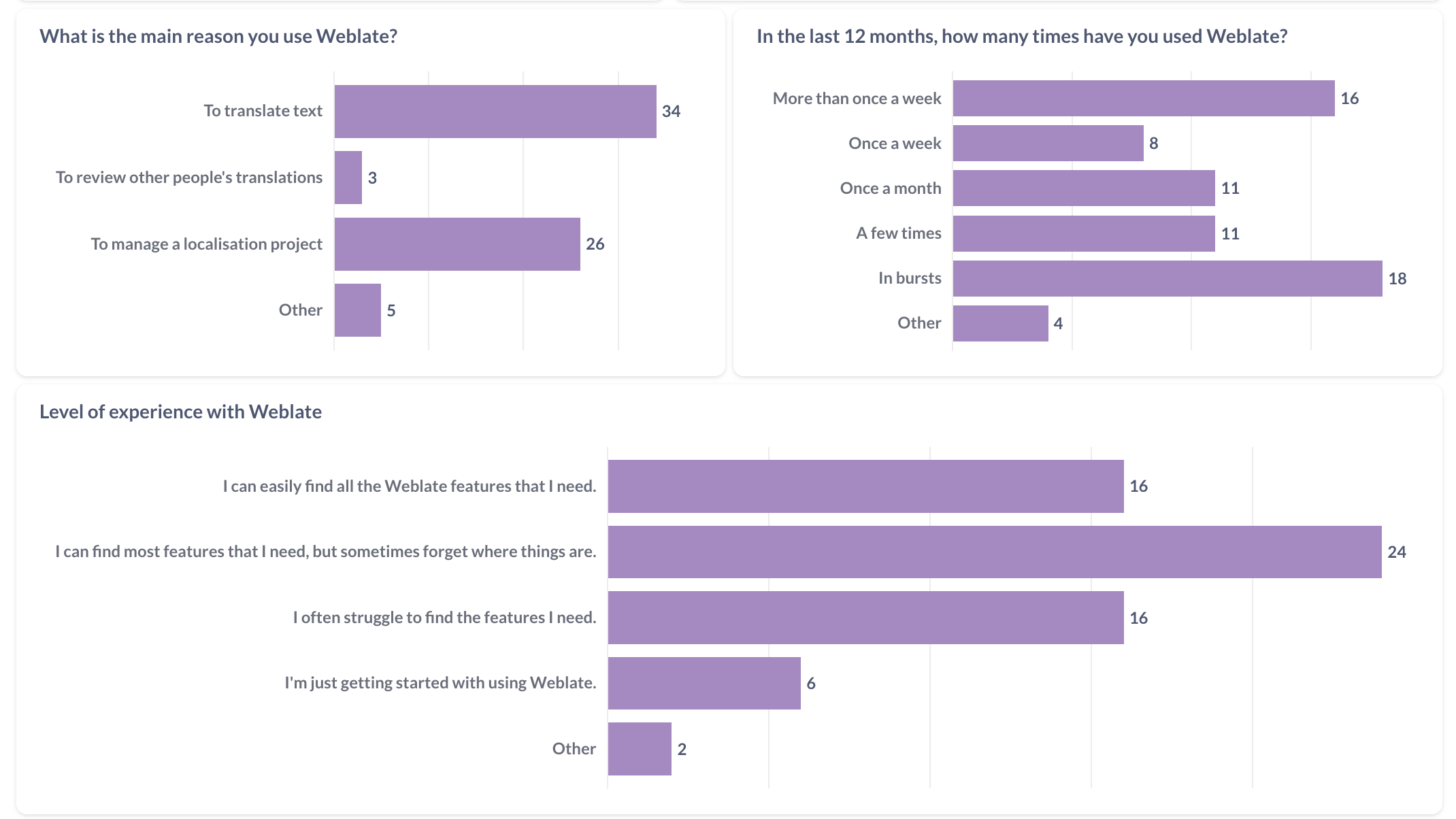
15 interviews and 68 survey responses analysed. The headline finding: Weblate has most of the features its users need, but interface complexity is preventing people from finding or using them. We proposed four solutions sequenced across three implementation stages, prioritising the lowest-effort highest-impact changes first.
Project kickoff and research scoping
Aligned with Ura Design on tasks, timelines and responsibilities. Interviewed Localization Lab and Weblate to gain historical context and define user personas. Established shared research infrastructure. Started scheduling interviews